| |
|
Click on a thumbnail picture below to see the full size version.
|
20 Entries.
|
|
Thursday, March 12
|
View Page
|
 |
Hello folks! This is my inaugural grower's diary entry, so I think it's only appropriate to take this opportunity to introduce myself.
My name is Cassidy, hereafter known as "Gardeneer-in-Training," or GIT as pumpkinpal2 christened me. First and foremost, I am male, despite the fact that my name is commonly considered feminine. I suppose it's better than being a boy named Sue. ;)
I was born and raised in the sunny Okanagan Valley in British Columbia, Canada. Our winters are somewhat mild, the frost hangs on far too late, and our summers get hit enough to rival Arizona or California. I've heard it said that the Okanagan is the Napa Valley of Canada. It is, in fact, Canada's only true desert, and yes, we technically have scorpions despite my never seeing one. A frozen wasteland it is not.
|
|
|
Thursday, March 19
|
View Page
|
 |
Somehow, my upbringing led me to pursue an education and career in civil engineering. To pay for my education, I went to work in orchards and small family farms every summer (we simply don't have giant commercial farming operations like in the States). My parents thought that the work would do me some good, to learn the value of a dollar. They were right, but it also changed me, somehow. I'd never cared much for gardening growing up, but something about nurturing a crop along was infectiously exciting. I relished the challenge. But I was merely tending to fruit trees and vegetable crops (the Okanagan, like parts of Ontario and Washington, is renowned for our orchards). It was enjoyable work, but it wasn't something I did at home. And then, the pumpkin arrived.
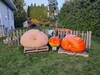
Fall and Halloween were a highlight of my childhood years. My mother always put a herculean effort into decorating, the bulk of which consisted of various gourds, squash, and pumpkins.
|
|
|
Thursday, March 19
|
View Page
|
 |
Continuing from my previous entry...
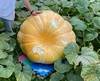
I got it in my head, in my teens, that I ought to try saving seeds and plant them the following spring to save some cash. I did just that, but at the same time, my mother brought a pumpkin seedling home from a nursery. It received no care, but come Halloween, we had a 50 lb pumpkin. At the time, I was in awe of its size, until my father did a quick internet search that revealed an entire world of pumpkins weighing in excess of 2000 lbs.
2024 was a reset year, for many reasons. I was no longer in university, I'd learned some hard lessons, and I was armed with sage advice from a couple of books written by giant pumpkin growers. I managed to grow 320 and 415 lb pumpkins, although the 415 suffered severe sunscald and never made it to a weigh-off.
|
|
|
Friday, March 20
|
View Page
|
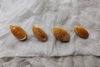 |
I started my seeds yesterday after getting home from work. I've got the process perfected to the hour, which saved me last year when I poached my first set of seeds. I spent all of Wednesday evening labeling and filing the edges of the 15 seeds I've selected. As soon as I walked in the door yesterday afternoon, the seeds underwent a 6 hour soak in warm water, then were wrapped in moist (not dripping wet) paper towels in labeled plastic bags on my germination mat. This process regularly results in seeds sprouting 33 hours after the 6 hour soak, so those that germinate on time will be ready for planting shortly after 7am tomorrow (Saturday). That gives me plenty of time to wait for stragglers, or even start a second set of seeds should something go wrong.
I know that this might be a little early, but I'm keeping a close eye on temperatures and vapour pressure deficits, and I think I can give myself a solid head start with the help of soil heating cables, cold frames, and heaters.
|
|
|
Wednesday, March 25
|
View Page
|
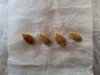 |
My seed selection this year was based on a preference for 1885.5 Werner and 1501 VanderWielen genetics. My top picks are the 1232 Dill, 2388.5 Liggett, 1886 Sexton, 1060.5 Maydan, but I've also got some other promising seeds like the 1348 Abbate and 1758 Palmberg. I checked on the seeds exactly 33 hours after finishing the 6 hour soak, and most of these seeds were already sprouting. The 1232 Dill had a slight lead on everything else, which is exciting, but to say it's still early would be an understatement. I'm a patient fellow, but when it comes to seedlings, I can't resist poking around in the soil to check for developments. I expect most of them to be breaking ground sometime tomorrow or Thursday.
My initial batch of my own seeds from last year yielded disappointing germination results, but a second test that accidentally included an 8 hour soak had an 8/10 success rate. Perhaps the seed shell was too thick, and a 6 hour soak was insufficient?
|
|
|
Wednesday, March 25
|
View Page
|
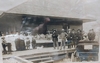 |
There's a farming community north of where I live that I love to visit. It's a refreshing change from the hustle and bustle of everyday city life. Anyways, there's one stop in particular that I like to make, that being at an antique store just off of Main Street. Well, I was there a couple weeks ago, and happened to notice a photograph propped up behind some brick-a-brack, somewhat out of place. I don't know what drew me to the photo, but I picked it up and barely managed to contain my exuberance when I understood what I was looking at.
I present to you, ladies and gentlemen, photographic evidence of giant pumpkins (presumably of the Mammoth variety) being grown in British Columbia's interior.
The photo bore no accompanying notes or captions, but a little investigative work proved fruitful. I'll include a picture of what I found in my research in a follow-up entry, along with an explanation of how I figured it out.
The photo was not an original, but the quality was quite decent. Nevertheless, it was in plastic wrapping and thus the photo I took has a bit of glare, for which I apologize.
|
|
|
Thursday, March 26
|
View Page
|
 |
The University of British Columbia has an extensive archive of historical newspapers that have been digitized and are searchable. I've used them for genealogical research purposes, but I'd never thought to search for giant pumpkins. Based on the era that the photograph in my previous entry was taken and knowing the nature of small town newspapers, I imagined that I might try searching for context to that photograph in the historical newspapers collection. It only took a little over an hour of searching, and I found the following paragraph (clipping of the original attached) in the Hedley Gazette, dated October 10th, 1907:
"The arrival of the first passenger train is always an important event in the history of a town. Keremeos passed that milestone on Oct. 5th at noon. The station platform was crowded with deeply interested spectators to witness that event. At the east end of the station on a raised stand there was a fine display of fruit and vegetables. The MacIntosh red and Gravenstein by Mrs. Daly; an equally fine assortment of apples and a cluster of four large apples by the Beautiful Valley Land Company ; a box of very tempting grapes by Mr. F. Richter; a giant pumpkin weighing 125 lbs. and measuring 8 ft. 7 in. in circumference, with several of 100 lbs., a potato vine 7 ft. and a tomato vine 8 ft. in length, by Messrs. Mattice and sons, told the story in a most eloquent and convincing way of the productiveness of the Similkameen. In a few years the Similkameen will be the glory of British Columbia for grapes, peaches, figs etc. Station agent McDaniels and conductor Brown made things as easy as possible for the kodak fiends and some good views were obtained by them."
I was able to confirm that the building in the photograph was the newly constructed train station in the town of Keremeos, and there was indeed a Central Hotel that was evidently eager to capitalize on the passengers arriving on that first passenger train.
|
|
|
Friday, March 27
|
View Page
|
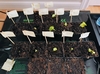 |
One of the most delightful parts of seed selection is dreaming of the crosses I think will compliment the traits I want to encourage in any future progeny. Perhaps that is the root of my inability to narrow down my seed choice? Fortunately, I am spoiled for choice, thanks to a variety of individuals. I want to take the time to sing their praises in future entries, but for the sake of conciseness I'll simply name some of them here; never let it be said that there is a selfish bone in Jordan Abbate, Danny Dill, Bill Sexton, Chad New, Joe Ailts, or Steve Maydan. I would love nothing more than to have enough space to plant all of the seeds they've shared with me, but alas.
I mentioned in a previous entry which seeds I was most excited for, but here's a complete list of this season's contenders:
2388.5 Liggett 2023, 1232 Dill 2024, 1060.5 Maydan 2022, 1886 Sexton 2024, two 1348 Abbate 2025, two 1758 Palmberg 2025, 490 Murrell 2025, two 415 Murrell 2024, 320 Murrell 2024, and three 962 Murrell 2025.
None of my own seeds will ever see dirt in my patch, they're only being used as benchmarking because I'm familiar with their growth habits from last year. It is possible that they will find homes in some other folk's yards.
I actually gave one of my 2388.5 Liggett 2023s to a friend who helped me a great deal last year, even while battling to save his pumpkins from maladies. He grew a stunning orange beauty in 2024, and I believe he intends on crossing it with the 2388.5, a cross similar to that which I am hopeful to make.
|
|
|
Sunday, March 29
|
View Page
|
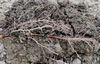 |
I was turning over some of my patch this past weekend and found this nice soil profile. This time last year, I had just converted a section of lawn into a pumpkin patch. The soil was originally pure clay, but was amended with peat moss, compost from the municipal landfill, and some synthetic fertilizers. In the fall, both my 490 and 962 were painstakingly cut up into pieces, hauled over to the patch, and broken up even further with the aid of a shovel. Instead of burying the pumpkin remains, I attempted to rototill them in to incorporate them into the wet soil. This went down about as poorly as one might have imagined. Rather than bury the plant matter by hand, I did the next bet thing to hide the ghastly sight of pumpkin carcasses decaying in the yard:I buried them under a layer of leaves! To my surprise and delight, all 1500 lbs of pumpkin have since decomposed, and I have a darker, less clayey layer of topsoil to work with this season.
The picture seen here illustrates the tan-coloured, native clays I started with and which surround and underlie the patch, and above the tan clay is a darker, more crumbly clay layer. Of particular interest is the tree root in the photo. Note that it runs horizontally along the interface of the two soil layers, with smaller roots/rootlets extending upwards into the patch, and scarcely any penetrating the undisturbed clay layer below. I imagine my pumpkins behaved much in the same manner last year. Their roots likely went down about 12-18 inches and hit the native clay, then spread horizontally.
The key takeaway from this entry is that the importance of soil texture and porosity cannot be understated, and the deeper one breaks up the native soils, the better. That is especially true for clay soils, otherwise a pumpkin patch is simply a clay basin from which excess water cannot drain.
|
|
|
Sunday, April 26
|
View Page
|
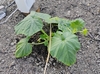 |
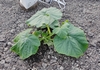
I apologize for the irregular diary entries. A great deal has transpired over the last few weeks. It is far too much to cover in a single entry, but I thought I would start by introducing my final picks, which are already transplanted and settling into the patch quite nicely. The most robust of the seedlings, a 1232 Dill, has been given the northern, more sheltered end of the patch. It has already overcome a few challenges that might have spelled disaster, but its resilience is what earned it a place in the patch and its name. This, ladies and gentlemen, is Indomitable.
|
|
|
Sunday, April 26
|
View Page
|
 |
The second plant will be my main plant. Its lineage is legendary, and I expect to achieve great feats with it. That said, it's most deserving of its name: Inimitable.
|
|
|
Saturday, May 9
|
View Page
|
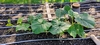 |
Inimitable (2388.5 Liggett 2023) as she was on May 9th. Healthy green colour and good vigor.
|
|
|
Saturday, May 9
|
View Page
|
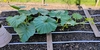 |
Indomitable (1232 Dill 2024) on the morning of May 9th. She's a beautiful plant, and I'm hopeful for her.
|
|
|
Wednesday, May 20
|
View Page
|
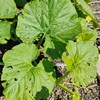 |
I returned from the long weekend to both Inimitable and Indomitable having their leaves perforated with holes. Either we got some hail, or the squirrels have taken up arms. Either scenario is a real possibility.
|
|
|
Wednesday, May 20
|
View Page
|
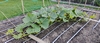 |
Inimitable (2388.5 Liggett) on May 20th. Note the hail-torn leaves.
|
|
|
Wednesday, May 20
|
View Page
|
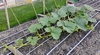 |
Indomitable (1232 Dill) living up to her name, looking good on May 20th despite the obvious hail damage.
|
|
|
Wednesday, May 20
|
View Page
|
 |
The first female bud has appeared on Inimitable! I had planned for a pollination window starting on June 6th, and it's looking increasingly likely that I'll be able to hit the earlier part of that window!
|
|
|
Wednesday, May 27
|
View Page
|
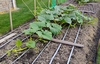 |
The first female blossom appeared on Indomitable (1232 Dill) May 27th. She's in a more sheltered location than Inimitable, which is likely what's setting the two plants apart.
|
|
|
Wednesday, May 27
|
View Page
|
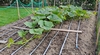 |
Inimitable (2388.5 Liggett) is an amazing plant. Very robust, vigorous growth. A dear friend of mine found himself short of seeds this year, so I mailed him my spare 2388.5 Liggett seed. I am delighted to report that he is also noting rapid growth. It's surprisingly fun to grow "sibling" pumpkins, as we enjoy comparing plant physiology and trying to understand what's influenced by genetics and what's influenced by environment. He has a much more temperate climate, whereas I'm going to have a much hotter, drier summer. That's why I wanted to get a head start this year, to establish the plants before the heat wave came.
|
|
|
Tuesday, June 2
|
View Page
|
 |
The first (and only) female I've pollinated on Indomitable (1232 Dill) was a perfectly formed six-lober. I selfed it, not because I wanted to, but because I just didn't have the time to pollinate. I've let a few other female blossoms on the same plant open without being pollinated for the same reason, and now it looks like I won't have any more for several days. There is no sign of any females in the growing tip of the main vines, which is doubly concerning because by the time they appear on the secondaries, I'm terminating them, and there isn't much room left for the main vine. If I don't see more females in the next two weeks, I will very likely have to pull the plant so that Inimitable can make use of the space.
Speaking of, I'm facing the same time constraint problems with the 2388 Liggett. I've made four pollinations, but two were selfed (not what I wanted) and two were done late in the evening, long after the blossoms would have opened if I hadn't tied them shut. I probably shouldn't have bothered with the last two, but it may just serve as an experiment in how late one can successfully pollinate.
I find it very discouraging when I've put considerable effort into setting myself up to beat my personal best, and I can't find time to actually do the single most important task to actually get a pumpkin. It doesn't help that the weather has turned cooler.
|
|
|
|




 Gardeneer-in-Training - 2026 Grower Diary
