| |
|
Entry Date
|
Nick Name
|
Location
|
|
Wednesday, July 08, 2026
|

|
Matt D.
|
Connecticut
|
 |
Entry 17 of 33 |
 |
|
|
|
Natural Light on a Sunny July Day
The use of shade cloth has become increasingly common among giant pumpkin growers, with many reporting anecdotal improvements in plant health. Early in the season, shade cloth can help reduce leaf burn, maintain more consistent canopy temperatures, and mitigate wilting and water stress associated with intense sunlight and heat.
Despite these observations, few growers quantify actual light intensity-specifically PAR (Photosynthetically Active Radiation). PAR represents the wavelengths between 400-700 nm, which are the primary spectrum used in photosynthesis. Accurate measurement requires a dedicated PAR meter, a tool that can be difficult to justify given its cost relative to the data it provides. To help growers better understand light intensity and the impact of shade netting, the following information offers practical reference values without requiring specialized equipment.
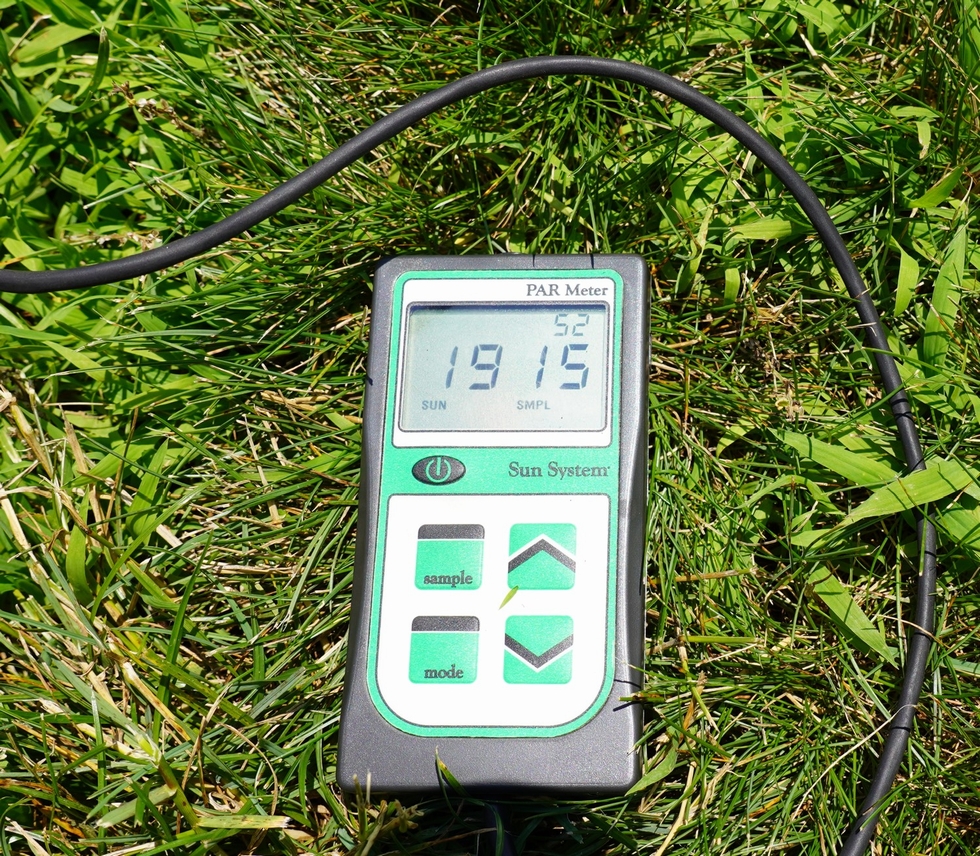
For comparison, a "control" reading was taken on a sunny July day in Southern New England. Measurements were collected around midday in an open lawn under full sunlight. The resulting PAR value was 1915 μmol/m²/s. For context, typical maximum PAR levels under completely clear midsummer skies approach 2000 μmol/m²/s, indicating that the conditions during measurement were near peak natural light intensity.
It is important to note that PAR readings fluctuate slightly due to passing high level clouds and the sensitivity of the meter, which detects even minor variations in light. For clarity and consistency, average values are used for comparison throughout this discussion.
|
|
|